Hallowe’en & Trick-or-Treats: A History | #PSC 159
This episode of #PodSaveChocolate takes a look at the history of Hallowe’en from its pagan roots through the history of trick-or-treating to today. [updated]
When and Where to Watch
Links below to watch LIVE and to view the archived episode.
Note: Fall (back) Daylight Saving Time occurs over the weekend following Hallowe’en. The next episode (on Tuesday, November 4th – Election Day here in the US) will still start at 11:00 MST. That’s one hour earlier in the Pacific, Central, and Eastern US time zones.

Click on this (shareable) link to watch on YouTube. Please subscribe (free!) to the @PodSaveChocolate YouTube channel, like this video, comment, and share this episode to help grow the #PSC community.

Watch and comment LIVE or view the archived episode on LinkedIn. Join my network on LinkedIn to receive notifications and to refer business to each other.

Watch and comment LIVE or view the archived episode (for 30 days from the date of the livestream; thereafter on YouTube) on TheChocolateLife page on Facebook. (Follow TheChocolateLife on Facebook to receive notifications and catch up on other content.)
Overview - Episode 159
What is Hallowe’en? Why is it celebrated? When and where did it “start?” When did gifting become a part of the celebration? And where does candy figure in?
All those and more in this episode of PodSave Chocolate.
secret chocolate obsessions
I mentioned this in the previous episode because, to many, it seems out of place. I have the opportunity to eat some of the finest chocolate bars, bonbons, and pastries in the world, so why do you covet cheap candy? (Hint: One reason I call them secret chocolate obsessions.)
 Clay Gordon
When I was working with the publishers of Chocolatier Magazine, I started a series titled Secret Chocolate Obsessions. In this series, I interviewed well-known pastry chefs and chocolatiers and asked them, “When you’re not eating your own work, what chocolates do you eat?”
Some of the answers surprised me.
One interviewee, a pastry chef, born and trained in France, said Snickers bars. A French pastry chef and peanuts. Je fais une syncope!
Another interviewee, an American-born pastry chef known for creating Asian-inspired desserts, said Maltesers.
I have three.
While all three of these products are available 24/7/365, I only indulged in them around Hallowe’en, and now that my children are no longer actively trick-or-treating and I am not buying candy to give to local ToTs (Trick-or-Treaters), I can’t recall the last time I indulged in any of them. They are, in descending order of preference:
- Butterfinger
- Almond Joy (not Mounds! – way too sweet)
- Reese’s Peanut Butter Cups (the original only, none of the newfangled versions)
What are yours? I know you have at least one.
How would you rank yours on a Tier List? Here’s my first attempt:
| Tier | Rankings |
|---|---|
| S | Butterfinger |
| A | Almond Joy, Reese’s Peanut Butter Cups |
| B | Snickers, Peanut/Almond M&Ms, Bit o’Honey, Goldberg’s Peanut Chews, Baby Ruth |
| O | Three Musketeers, Milky Way/Mars bar, Kit Kat, Twix, Plain M&Ms, Mr Goodbar, Payday, Skittles, SweeTARTS |
| C | Hershey with almonds, Sour (covered with citric acid) anything, Nerds, Krackel |
| D | Hershey bar/kisses, Sugar candy (Lifesavers, any flavor; buttercotch, mint), Gum (any kind), gum drops |
| F | NECCO wafers, candy corn, gum drops covered with non-pareils, wax bottles filled with flavored and colored syrups |
hallowe’en through history
Halloween traces back to the ancient Celtic festival of Samhain (pronounced “SAH'-win”), marking summer’s end and the start of the dark half of the year around November 1. People believed the boundary between worlds thinned; they lit bonfires, wore disguises to confuse spirits, and performed divination.
Primary evidence is sparse and late. Earlier references (10th–12th century Irish tales) are brief; detailed descriptions mainly appear in 18th‑century accounts from Ireland, Scotland, Wales, and the Isle of Man. Reported practices include bonfires for protection, divination rituals, apotropaic objects (e.g., straw crosses), feasting, storytelling, serving food to the dead, and “dumb suppers” for matrimonial divination. Some traditions linked Samhain to pastoral cycles (bringing in cattle, slaughtering pigs) and possibly treated it as a New Year, though this is inconclusive.
— Summary of an Encyclopedia Britannica article
With Christianization, the Church established All Saints’ Day (All Hallows) on November 1 and All Souls’ Day on November 2; the evening before became All Hallows’ Eve, blending older practices with Christian remembrance of the dead.
Samhain coincides with Christian Allhallowtide (All Hallows’ Eve, All Saints’ Day, All Souls’ Day), established independently in the 9th century. Halloween emerged from the blending of these Christian observances with regional folk practices; specific Samhain carryovers (masks, carved turnips/pumpkins, mumming) are debated and may reflect later local traditions rather than direct continuity.
— Summary of an Encyclopedia Britannica article
Irish and Scottish immigrants carried these practices to the United States in the 19th century.
Pumpkins became tied to Halloween in North America during the mid‑to‑late 19th century, as immigrant turnip/beet “jack‑o’-lanterns” shifted to abundant pumpkins; newspapers record carved pumpkin lanterns by 1866.
The carving tradition is older and Celtic (lantern faces on turnips or beets used at Samhain to ward spirits), but in the U.S. and Canada the practice adapted to native pumpkins and migrated from general harvest décor to Halloween symbolism. A Kingston, Ontario Daily News item (Nov. 1, 1866) already describes “transparent heads and face” carved from pumpkins for Hallowe’en; by the 1880s–1890s, American articles contrast British bonfires with U.S. boys’ “funny grinning jack-o’-lanterns” made from “huge yellow pumpkins,” and even recommend lit pumpkin lanterns as Thanksgiving prizes before the association consolidates around Halloween.
— various sources including Wikipedia and the Library of Congress.
Hallowe’en or Halloween?
The word comes from the phrase “All Hallows’ Even,” the evening before All Saints’ Day. In Scots and older English, evening was commonly contracted to e’en, so the festival became Hallowe’en, with the apostrophe signaling the omitted letters.
As spelling standardized, especially in the 20th century, the compound form without an apostrophe – Halloween – prevailed in print, advertising, and style guides. Today, Hallowe’en reads as archaic or poetic.
trick-or-treating through history
Medieval and early modern customs around the holiday included souling (poor folk begging for alms or “soul cakes” in exchange for prayers), mumming and guising (costumed visits and performances), and warding rituals.

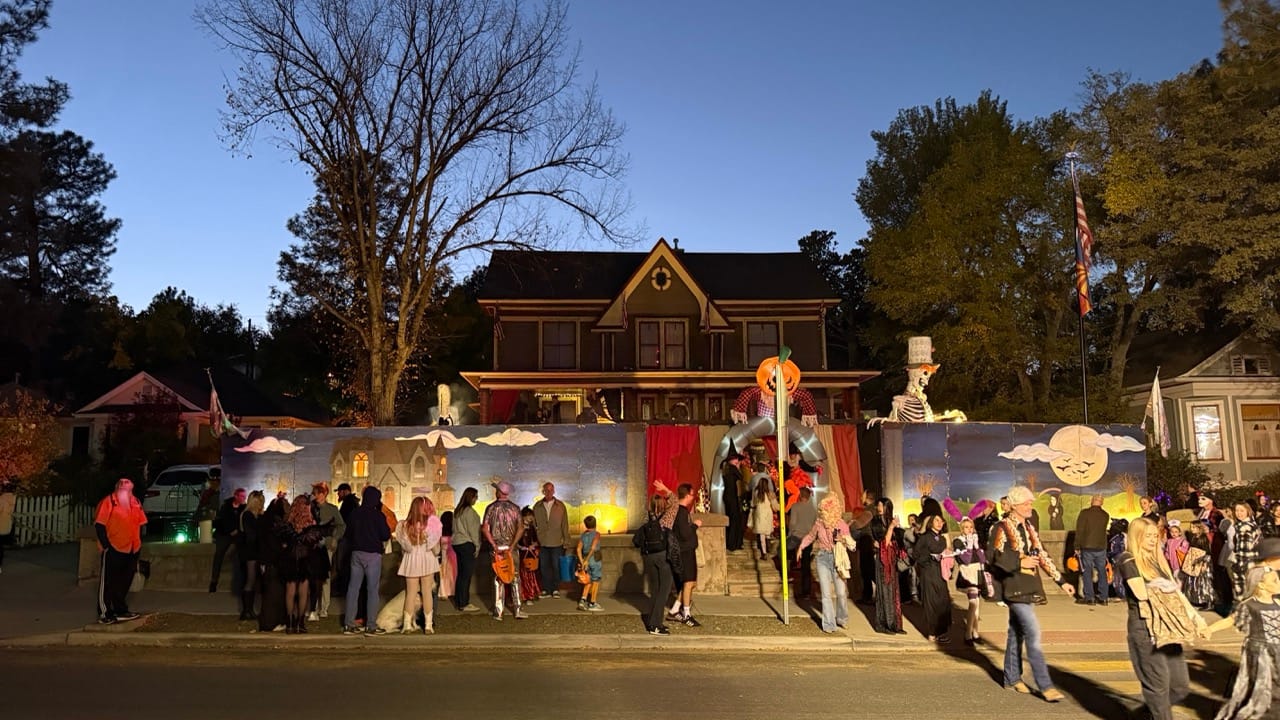
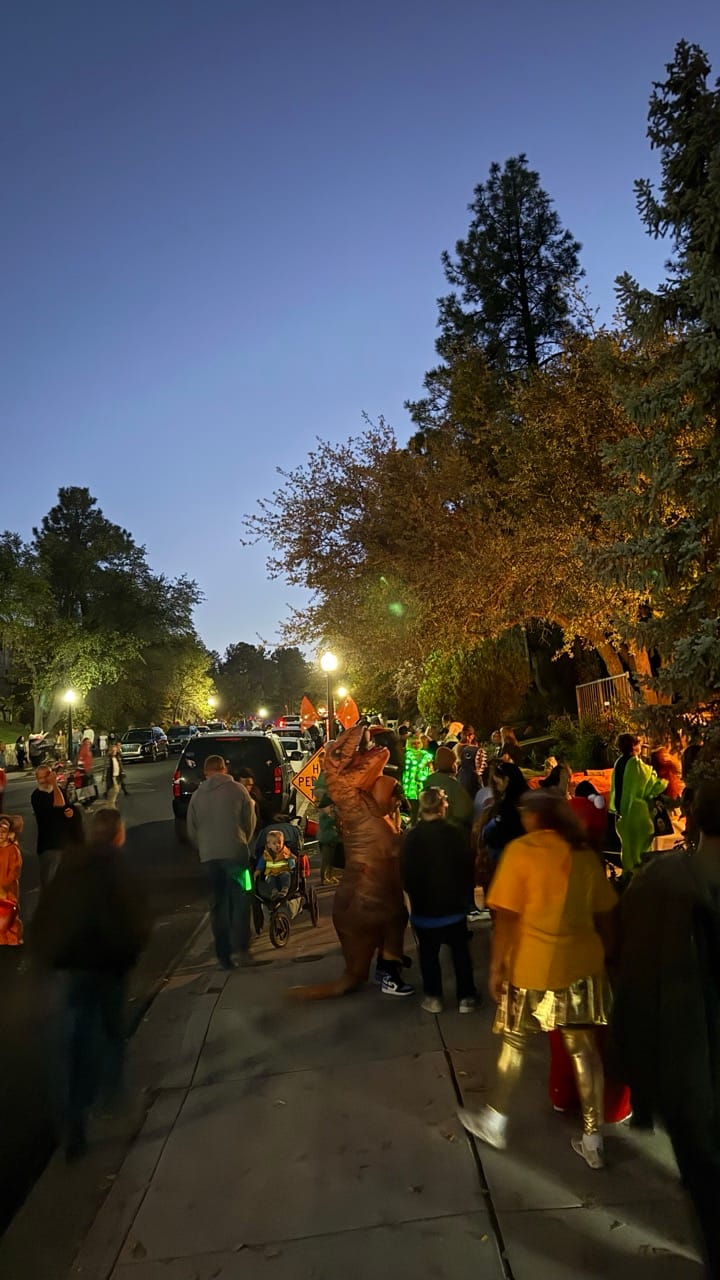
[L] A local walk-through scare house under construction in my neighborhood. [C] A major attraction – the wait was about an hour. [R] The street is one of two destinations. I live right around the corner and to say it was thronging is to understate. Most amazing is how little litter there was the next morning.
The child-centered phrase “trick or treat” likely originated in Canada in 1917 (the first U.S. newspaper in 1928, with the first national‑publication mention in the US in 1939), spread via newspapers and community campaigns in the 1930s through 1950s, driven by postwar candy marketing, led by Hershey, Mars, Curtiss, and Brach’s (circa late 1940s, early 1950s).
- Earliest: 1917 Sault Ste. Marie, Ontario (“tricks or treats”).
- Early variants: 1921–1924 in Ontario/Alberta; 1923–1924 Canadian newspaper examples.
- U.S. newspapers: 1928 Bay City (MI) Times reference; broader U.S. spread in 1930s–1940s; first national publication by 1939.
Between 1928 and WWII, households handed out apples, nuts, coins, and homemade popcorn balls and cookies; store-bought hard candies and simple chocolate bars were part of this early gifting, but slowed considerably when sugar began to be rationed.
Commercial candy tie-ins to Halloween began to accelerate after wartime sugar rationing in the US ended in 1947, as suburbanization and mass media normalized door-to-door candy canvassing. Major brands, including Hershey, Mars, Curtiss, and Brach’s, began to place Halloween-specific ads and produce packaging by the late 1940s and especially early 1950s that made it easy (and sanitary/safer) to hand out their candy.
 tovintagelizze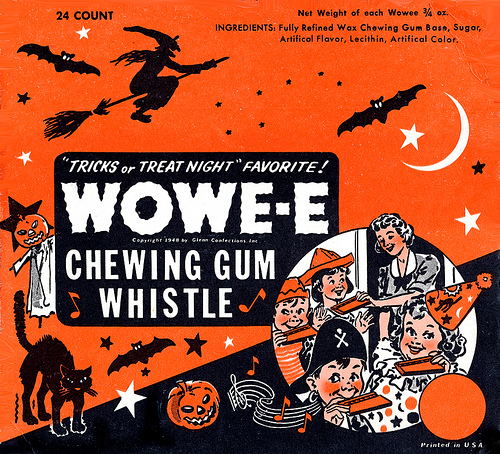
- Postwar pivot to candy: 1947 children’s magazines (Jack and Jill) depict house-to-house candy; radio/TV episodes in 1946–1952 further normalize it; industry shifts October ad spend to promote packaged handouts.
- Category leadership: Hershey and Mars’ WWII-scale production and postwar distribution help make them “Halloween candy kings,” seeding brand dominance in the late 1940s–1950s.
- Ad language timing: local papers begin using “trick-or-treat” in ads by the mid‑1940s (e.g., 1943 in Lancaster County), with prominent retail promotions by 1952.
- Cultural cementing: Peanuts (The Great Pumpkin is first mentioned in the October 26, 1959 strip) and Disney’s Trick or Treat (1952) show the custom fully mainstream, aligning with candy marketing cycles.
Trick-or-Treating Trends
2025 Stats
An estimated 41 million children will flood neighborhoods across America tonight in search of tricks or treats. With nearly three-quarters of households participating, spending is expected to reach $13.1B, up 13% from last year, as families spend an average of $114 each on costumes, decorations, and candy, totaling $4.3B, $4.2B, and $3.9B, respectively.
About 36% of Americans say Halloween is their favorite holiday, with New York City ranking as the best place to celebrate. Top costumes this year include characters from “K-pop Demon Hunters,” the “Minecraft” Chicken Jockey, and Labubu dolls.
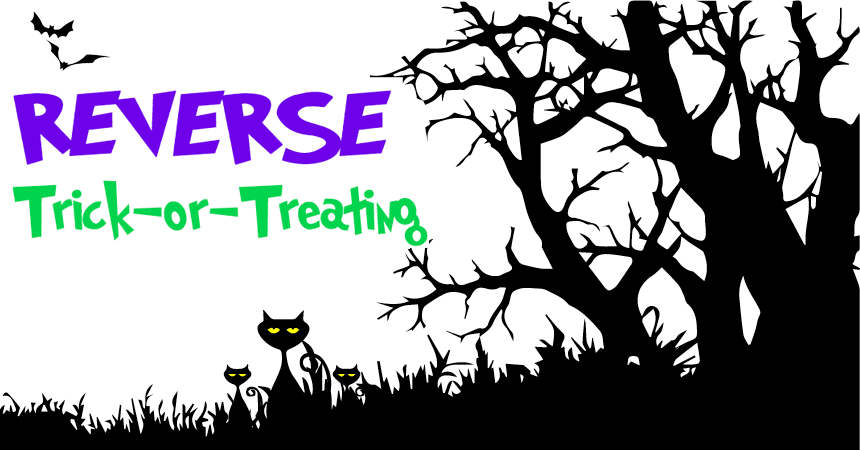
Ethical Halloween chocolate messaging emerged mid-2000s, led by advocacy campaigns like Reverse Trick‑or‑Treating (from 2007) and “Raise the Bar, Hershey” (2010), then amplified by NGOs, certifiers, and mission-led brands.
Why Halloween? Halloween is the single largest annual surge in U.S. chocolate purchases, so campaigns concentrated on education, petitions, and ethical alternatives around October to maximize consumer attention and leverage seasonal media. That seasonal strategy appears consistently from 2007 onward in NGO kits, scorecards, film screenings, and brand activations.
Allergen-Free
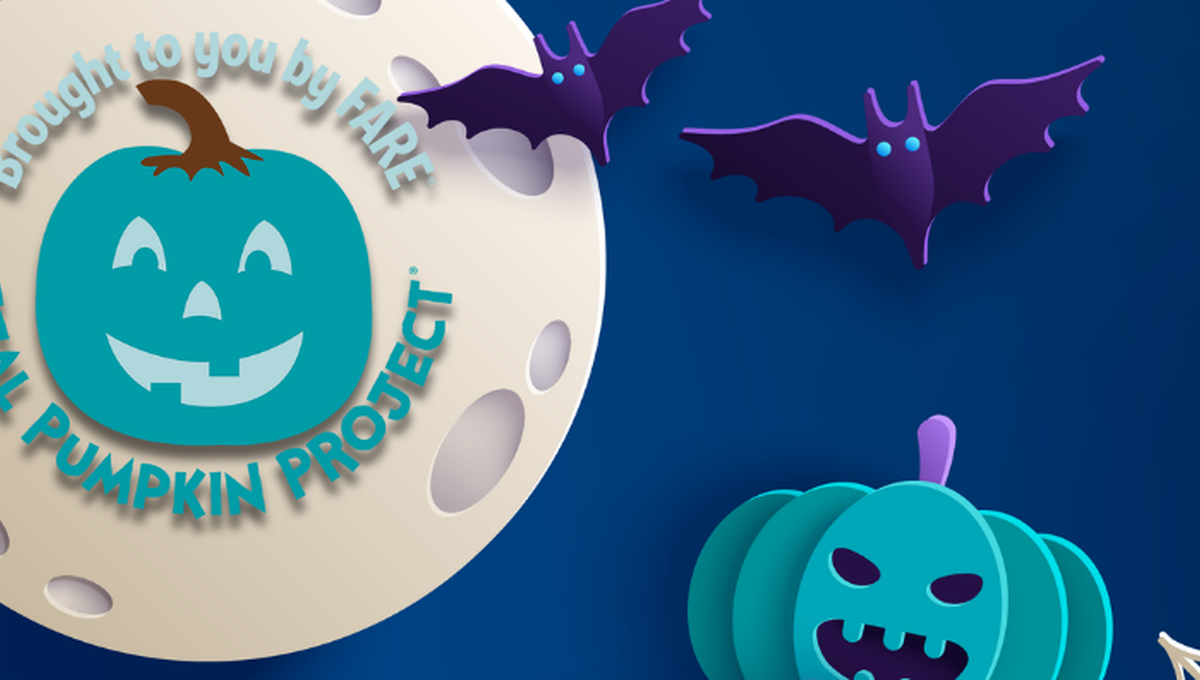
The Teal Pumpkin Project is a nationwide effort to make trick‑or‑treating safer for kids with food allergies. Households place a teal pumpkin or sign to indicate they have non‑food treats—stickers, pencils, glow sticks—in a separate bowl, so children can participate without exposure risks. It also includes a public map of participating homes and event listings.
Leadership and coordination sit with FARE (Food Allergy Research & Education), a U.S. nonprofit that runs the campaign, maintains the map, publishes printable signage, and partners with retailers to expand availability of allergy‑friendly items.

Comments? Questions?
If you have questions or want to comment, you can do so during the episode or, if you are a ChocolateLife member, you can add them in the Comments below at any time.
Episode Hashtags and Socials
#halloween
#cocoa #cacao #cacau
#chocolate #chocolat #craftchocolate
#PodSaveChoc #PSC
#LaVidaCocoa #TheChocolateLife
Future Episodes
#PodSaveChocolate and #TheChocolateLifeLIVE Archives
To read an archived post and find the links to watch archived episodes, click on one of the bookmark cards below.
 Clay Gordon
 Clay Gordon


Audio-only podcasts