Debunking Chocolate Conspiracy Theories | #PodSaveChocolate Ep 152
#PodSaveChocolate Episode 152 takes a look at seven (plus one) Conspiracy Theories about chocolate that can be found making the rounds on social media channels – especially Reddit. [ Updated post-episode ]
When and Where to Watch
Links below to watch LIVE and to view the archived episode.

Click on this (shareable) link to watch on YouTube. Please subscribe (free!) to the @PodSaveChocolate YouTube channel, like this video, comment, and share this episode to help grow the #PSC community.

Watch and comment LIVE or view the archived episode on LinkedIn. Join my network on LinkedIn to receive notifications and to refer business to each other.

Watch and comment LIVE or view the archived episode on TheChocolateLife page on Facebook (for 30 days, then watch the archive on YouTube).
Follow TheChocolateLife on Facebook to receive notifications and catch up on other content.
Episode 152 Overview
Is any aspect of human existence safe from conspiracy theories?
From a brief review of Reddit, I have to say, sadly, that chocolate is not immune to conspiracy theories. In this episode, we’ll look at claims regarding:
- Dubai Chocolate
- Cost‑saving “switches” to white chocolate
- Price‑fixing cartels (Mars, Nestlé, Hershey…)
- WWII‑era “exploding” chocolate bomb (Nazi plot)
- Military‑ration chocolate as a psyop (U.S. D‑Ration)
- Kinder Surprise ban as a “cultural control” psyop
- “Chocolate as a mind‑control agent” (Cold‑War rumors)
- BONUS: White chocolate is not “real” chocolate
What Constitutes a Conspiracy?
| Conspiracy Element | What it Looks Like |
|---|---|
| Secrecy | Participants hide the plan from the public. |
| Coordination | Multiple actors work together toward a hidden goal. |
| Documented collusion | Leaked memos, whistle‑blower testimony, court filings, etc. |
| Intent to deceive | The purpose is to mislead for profit, power, or other gain. |
How Discussions Can Feel Conspiratorial
... when they are not
| Conspiracy Element | What it Looks Like |
|---|---|
| Misinformation memes | Social‑media posts can spread quickly, creating an echo chamber that feels secretive. |
| Proprietary processing | If claims of trade secrecy are involved, some individuals fill the gap with speculation, which can appear to conceal a hidden agenda. |
| Brand‑centric hype | High‑visibility marketing can be misinterpreted as a “cover‑up” of something nefarious. |
Point by Point
TL;DR Summary
| White‑chocolate cost‑cut | Cadbury swapped real chocolate for cheap white chocolate to offset cocoa price spikes | Cocoa‑price graphs, sudden product flood |
| Price‑fixing cartel | Mars/Nestlé/Hershey colluded to set chocolate‑bar prices in Canada | Competition‑Bureau filings, leaked meeting notes |
| Nazi chocolate bomb | Exploding chocolate bar intended for Churchill | Declassified MI5 notes, History.com article |
| Military‑ration psyop | WWII D‑Ration bar made nasty to limit consumption | Veteran testimonies, “Hitler’s Secret Weapon” nickname |
| Kinder Surprise ban | Safety pretext hides cultural‑control motive | FDA ban text, translation errors in warning sheets |
| Chocolate mind‑control | Governments added psychoactive agents to chocolate for morale/behavioral influence | References to MK‑Ultra, speculative “research” posts |
You can use the table above as the starting point for your own research as I deconstruct the theories to debunk them. Did I miss anything? Get something wrong? Let me know in the comments or during the livestream.

§1 – Dubai Chocolate
Key points that keep showing up in the various “Dubai Chocolate” conspiracy theory threads:
- Co‑ordinated influencer push – Many users speculate that the United Arab Emirates (or a state‑linked marketing agency) secretly recruited a wave of food influencers to hype the product. The narrative feels “too perfect”: a glossy, exotic‑flavoured bar gets massive exposure on TikTok/Instagram almost overnight, which some see as a deliberate PR operation rather than organic buzz.
- Distraction from human‑rights issues – The hype is framed as a “luxury‑image‑launderer.” The argument is that the bar’s glittery packaging and exotic ingredients (pistachio, rose, saffron, kadayif) are meant to mask the UAE’s broader reputation for labor exploitation, elite excess, and even the alleged prostitution‑tourism industry that fuels the country’s wealth.
- Sanitary‑concern cover‑up – A separate strand claims the chocolate is a front for a far less appetising reality: rumors of “poop‑flavoured” or “porta‑potty” origins, alleged salmonella outbreaks in pistachio fillings, and a foul foot‑like smell that users attribute to dirty, industrial‑scale production in unregulated Indian street‑market‑style facilities.
- Google‑search manipulation – Some theorists argue the term “Dubai Chocolate” was deliberately coined to divert online searches away from negative stories about the UAE (human‑rights abuses, exploitation, “porta‑potty” scandals). By flooding the web with food‑related results, the conspirators hope to bury critical coverage.
- Economic‑planning hype – The rapid, global rollout – large retailers, limited‑edition, gold‑infused bars, and pricey boutique versions - is viewed as a textbook example of top‑down economic planning: create a trendy product, seed it through influencers, and reap huge sales, while the underlying “story” remains hidden.
2) There are some OpEd pieces regarding distraction from human rights issues but there is no evidence that “Dubai” chocolate (“DC”) was specifically created to conceal them.
3) While there have been recalls over contaminated product, there are no credible sources that confirm DC was intentionally formulated to taste like poop – negative flavor/aroma concerns appear to be entirely anecdotal.
4) There are no verifiable sources for the claim that search engines intentionally manipulated search results.
5) When it comes to state-sponsored claims, while the results are evidence pointing to the commercial exploitation of a trend, there is no evidence of state-sponsored central planning.
Referring back to the four elements of a conspiracy in the table above, the tests for secrecy, coordination, documented collusion, and, most notably, intent to deceive are not met.
§2 – Switching to white chocolate to save money
What the rumor says – Brands such as Cadbury suddenly flooded shelves with white‑chocolate Easter eggs, Cadbury Mini‑Eggs, and other “white” chocolate variants.
Conspiracy theorists argue the move is a deliberate response to the recent spike in cocoa prices, letting the company cut costs by using cheap cocoa butter instead of real cocoa solids.
Why it sticks – The timing coincides with a sharp rise in West African cocoa disease and a corresponding price surge.
None of the elements of secrecy, intent to deceive, collusion, and coordination are all present here so the conspiracy fails in addition to being economic nonsense.
§3 Price-fixing cartels
What the rumor says – In Canada, the Competition Bureau charged the big chocolate makers (Mars, Nestlé, Hershey) with conspiring to fix the retail price of chocolate bars.
The allegation is that executives met in secret warehouses, exchanged “price‑setting” spreadsheets, and used “white‑noise” tactics (e.g., moving large bags of Skittles) to evade wiretaps.
Why it sticks – Official government press releases confirm the investigation, giving the theory a veneer of legitimacy that fuels speculation about “global chocolate oligarchs.”
However, because this is true in Canada, it does not automatically follow that there is a global conspiracy of chocolate oligarchs.
The elements of secrecy, intent to deceive, collusion, and coordination are all present here.
§4 WWII‑era “exploding” chocolate bomb (Nazi plot)
What the rumor says – Nazi agents allegedly prepared a chocolate bar (“Peter’s Chocolate”) that concealed a tiny steel‑and‑canvas charge.
When a soldier broke off the end of the bar, the hidden mechanism would trigger a seven‑second delayed explosion, intended for the British War Cabinet and even Winston Churchill, who was known for his sweet tooth.
Why it sticks – The story appears in a History.com feature that cites MI5 files, giving it an “official history” feel. The dramatic “chocolate bomb” image spreads quickly on Reddit’s r/history and r/conspiracy threads.
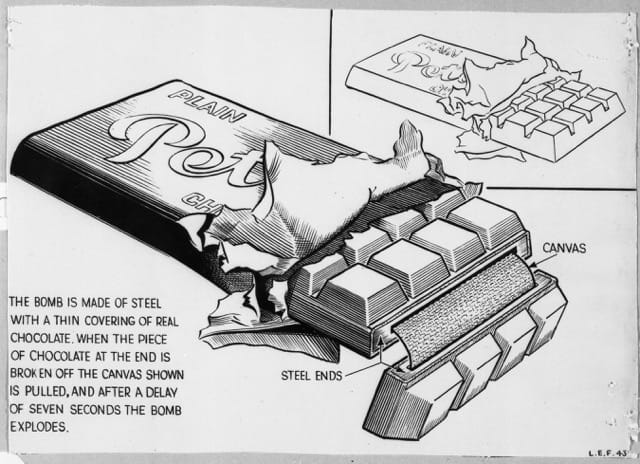
Exercise for the reader: But does this qualify as a conspiracy theory?
§5 Military‑ration psyop chocolate (U.S. D‑Ration)
What the rumor says – The U.S. Army’s D‑Ration chocolate bar, issued to soldiers in WWII, was deliberately formulated to taste terrible (high oat‑flour content, gritty texture).
Troops nicknamed it “Hitler’s Secret Weapon” because the unpleasant flavor discouraged casual eating, reserving the bar for emergencies and thus controlling soldiers’ caloric intake and morale.
Why it sticks – Veteran anecdotes and the “propaganda” framing in official histories make the claim feel like a hidden psychological operation.
But even if the claim is true, does it rise to the level of being a conspiracy? Where is the intent to keep it secret? To deceive?
§6 Kinder Surprise ban as a “cultural control” psyop
What the rumor says – The United States bans Kinder Surprise eggs (chocolate shells with hidden toys) under the 1938 Federal Food, Drug & Cosmetic Act.
Conspiracy theorists argue the ban is less about choking hazards and more about restricting a foreign cultural product, using safety rhetoric as a cover for a subtle “American‑values” enforcement.
Why it sticks – The ban is real, and the official safety warnings (34‑language warning sheets) contain occasional translation errors, which theorists cite as evidence of a rushed, deliberately opaque regulation.
There is no evidence the decision was made to protect “American values.” Where is the secrecy? The intent to deceive? Collusion?
§7 Chocolate as a mind‑control agent (Cold‑War rumors)
What the rumor says – Some fringe posts claim that governments (especially the CIA) experimented with high‑dose cocoa flavonoids and added psychoactive compounds to chocolate bars supplied to troops or civilians, aiming to boost morale or subtly influence cognition.
The narrative often ties into the well‑documented MK‑Ultra program, suggesting a “sweet” extension of the mind‑control agenda.
Why it sticks – The genuine existence of MK‑Ultra gives the claim a foothold; the lack of concrete evidence makes it a perfect “what‑if” scenario.
§8 White chocolate isn’t chocolate
I will admit up front that this is not a conspiracy theory. It is a delusion (a tightly held belief that resists all evidence to the contrary). I am including it here because it may be the most widely held misunderstanding about chocolate and it’s the one I encounter most often.
What the law says:
| EU (Regulation EU 1924/2006) | Must contain at least 35 % total cocoa solids (cocoa powder + cocoa butter) and at least 14 % cocoa butter. | Yes – white chocolate meets the cocoa‑butter requirement, even though it contains 0 % cocoa solids. |
| U.S. (FDA, 21 CFR 163.140) | Must contain at least 20 % cocoa butter, 3.5 % milkfat, and 3.5 % milk solids. | Yes – the FDA permits “white chocolate” as long as those percentages are met. |
| Canada, Australia, Japan | Similar cocoa‑butter thresholds; no requirement for cocoa solids. | Yes – white chocolate is legally “chocolate.” |
In most major food‑regulating bodies, white chocolate is legally classified as chocolate.
White chocolate contains not less than 20 percent by weight of cacao fat as calculated by subtracting from the weight of the total fat the weight of the milkfat, dividing the result by the weight of the finished white chocolate, and multiplying the quotient by 100. The finished white chocolate contains not less than 3.5 percent by weight of milkfat and not less than 14 percent by weight of total milk solids, calculated by using only those dairy ingredients specified in paragraph (b)(2) of this section, and not more than 55 percent by weight nutritive carbohydrate sweetener.
Why some argue that white chocolate isn’t “real” chocolate:
- Culinary perspective – Chefs and chocolatiers often classify chocolate by the presence of cocoa solids (cocoa powder, cocoa mass, or nibs). Without those, the flavor profile is fundamentally different.
- Consumer expectation – Most shoppers associate “chocolate” with brown color and a distinct cocoa taste. White chocolate can feel like a vanilla‑flavoured confection, leading to the perception that the label is misleading.
- Marketing motives – Some brands highlight “white chocolate” to command a premium price while using greater quantities of cheaper ingredients (sugar, milk solids). Critics sometimes view this as a marketing sleight‑of‑hand rather than a genuine product category.
These points may be legitimate criticisms of labeling and marketing, but they don’t involve secret agendas, hidden evidence, coordinated deception, or documented collusion.
About the Featured Image

Questions?
If you have questions or want to comment, you can do so during the episode or, if you are a ChocolateLife member, add them in the Comments below at any time.
Episode Hashtags and Socials
#ConspiracyTheory #ConspiracyTheories #psyop
#cocoa #cacao #cacau
#chocolate #chocolat #craftchocolate
#PodSaveChoc #PSC
#LaVidaCocoa #TheChocolateLife
Future Episodes
Midwest Craft Chocolate Festival Preview with founder Dustin Cornett
The Changing Landscape of Cacao Sourcing
Interview and Tasting with Tandy Peterson of Embers Chocolate.
#PodSaveChocolate and #TheChocolateLifeLIVE Archives
To read an archived post and find the links to watch archived episodes, click on one of the bookmark cards, below.
 Clay Gordon
 Clay Gordon


Audio-only podcasts
Become a Premium ChocolateLife Member!
| These offers are available to free members, so subscribe above then click one of the following links. | |
|---|---|
| Team TCL Member Monthly membership | First 2 months FREE (save $10/yr) |
| Team TCL Leader Monthly membership | First 2 months FREE (save $30/yr) |