Why the EPIC FAILURE of Cocoa Sustainability Initiatives? | #PSC 161
In episode 161 of #PodSaveChocolate, I will take a look at why cocoa sustainability initiatives have failed and why the failures were inevitable.
When and Where to Watch
Links below to watch LIVE and to view the archived episode.

Click on this (shareable) link to watch on YouTube. Please subscribe (free!) to the @PodSaveChocolate YouTube channel, like this video, comment, and share this episode to help grow the #PSC community.

Watch and comment LIVE or view the archived episode on LinkedIn. Join my network on LinkedIn to receive notifications and to refer business to each other.

Watch and comment LIVE or view the archived episode (for 30 days from the date of the livestream; thereafter on YouTube) on TheChocolateLife page on Facebook. (Follow TheChocolateLife on Facebook to receive notifications and catch up on other content.)
Overview - Episode 161
In Episode 160, I took a look at ARS 1000, a relatively new pan-African standards framework for sustainable cocoa.
In that episode, I pointed out that piling more (expensive – or at least beyond the reach of individual smallholder farmers) bureaucracy on top of existing bureaucracy is not a path to sustainable cocoa.

The LinkedIn post has some relevant comments.
I made a similar argument in episode 140, when I pointed out that the call for more monitoring by the ICI does not (can not) address the root causes of farmer poverty that too often lead to illegal child labor (as if illegal child labor is what is standing in the way of sustainable cocoa).
 Clay Gordon
Rethinking Sustainability
Let’s start by thinking about the definition of sustainability that is used in the ARS 1000 standard – Brundtland.
“Meeting present needs without compromising future generations’ ability to meet their own needs.”
The Brundtland Report’s widely cited definition of sustainable development also emphasizes prioritizing essential needs of the poor and recognizing limitations imposed by technology and social organization.
— See also the International Institute for Sustainable Development (IISD) page on this topic. Download “Our Common Future” aka the Brundtlandt Commission report.
The Fundamental Flaw In This Definition
For at least five years now, my definition of sustainable has had the following four elements:
- Environmental Sustainability – this element is explicitly acknowledged in Brundtland.
- Economic Sustainability – this element is vaguely implied in Brundtland.
- Social Sustainability – this element is vaguely implied in Brundtland.
- Market Sustainability – this element is nowhere to be seen in Brundtland, but, in my opinion, it is the key to the long-term success of the other three elements.
The first three elements can be seen as “problems” unique to producing countries. However, the fourth point recognizes that it is the consumers of cocoa (traders, processors, chocolate makers, candy/snack companies, confectioners, the public) who, ultimately, pay for everything.
Homework for the reader: Sort the 17 UN SDG’s into one or more of the three elements: Environmental, Economic, or Social.
Case Study: EUDR
One fundamental flaw of the EUDR is that it sets forth a regulatory framework without proposing a corresponding economic framework that is acceptable to the markets. All of the costs and activities associated with EUDR compliance are taxes on the system that raise prices.
Furthermore, the EUDR regulations were imposed by a consortium of consuming countries on producing countries: they are a form of environmental, economic, and social imperialism.
This makes sense(?) because regulators only know how to regulate, i.e., bureaucrats only know how to bureaucrat: They have one tool – regulations – so every problem can be solved with regulations.
But can they? Really?
Thinking about Boxes
I think it’s fair to assume that we are all familiar with the phrase:
Think outside the box.
Deepak Chopra suggested that it’s not enough to think outside the box:
You have to throw the box away.
To my way of thinking, it’s not enough to throw the box away:
You have to forget what boxes are to be truly innovative.
The idea underlying the need to forget what boxes are is the requirement to examine presuppositions when approaching problems, whether the problem is new or old.
If regulators think that “the problem” is in “third world countries,” aka developing nations, aka the global south, then the solutions to those problems “belong” in those places, not in “first world countries,” aka developed nations, aka the global north.
These phrases are implicit environmental, economic, and social imperialism.
It is only by acknowledging and accepting market impact and risks that the scales can begin to be balanced.
Without the actors in “first world countries,” aka developed nations, aka the global north, acknowledging and accepting their culpability and responsibility, no real, meaningful, long-term progress can be made.
The Certification Industrial Complex
In this respect, certifications such as “Fair” Trade are thinly-disguised “socially acceptable” economic imperialism.
Producers in “third world countries,” aka developing nations, aka the global south, pay for “the privilege” of being certified. However, the certifying bodies assume zero market risk – they do not guarantee that 100% of the product(s) certified will earn the premiums and benefits being paid for. Thus, they act as a tax on the system, raising prices.
But, it’s “Fair” trade.
For more on this topic, refer to the following post, especially the Ethics as Market Category section:
 Clay Gordon
The Cocoa Fox and the Cocoa Hen House
Nowhere can the inadequacy of relying on the regulatory approach be better seen than in the Harkin-Engel Protocol. After being signed in 2001, the issues the Protocol was created to address have not been resolved, more than twenty years later.
Putting the very entities that created the problems in charge of solving them is setting the stage for failure through self-dealing.
This is, in large part, due to the intransigence of signatories and the reluctance(?) of politicians and judges, who have actively decided not to hold the signatories to their promises – despite the hard work of organizations like International Rights Advocates to hold companies to the letter and the spirit of their promises.
 Contributors to Wikimedia projects
There is a huge amount of link rot when it comes to looking for documentary evidence in the US Congressional Record. Download the HEP (PDF), signed by members of the CMA, Harkin, Engel, and other congressmen, and witnessed by a director of the ILO.

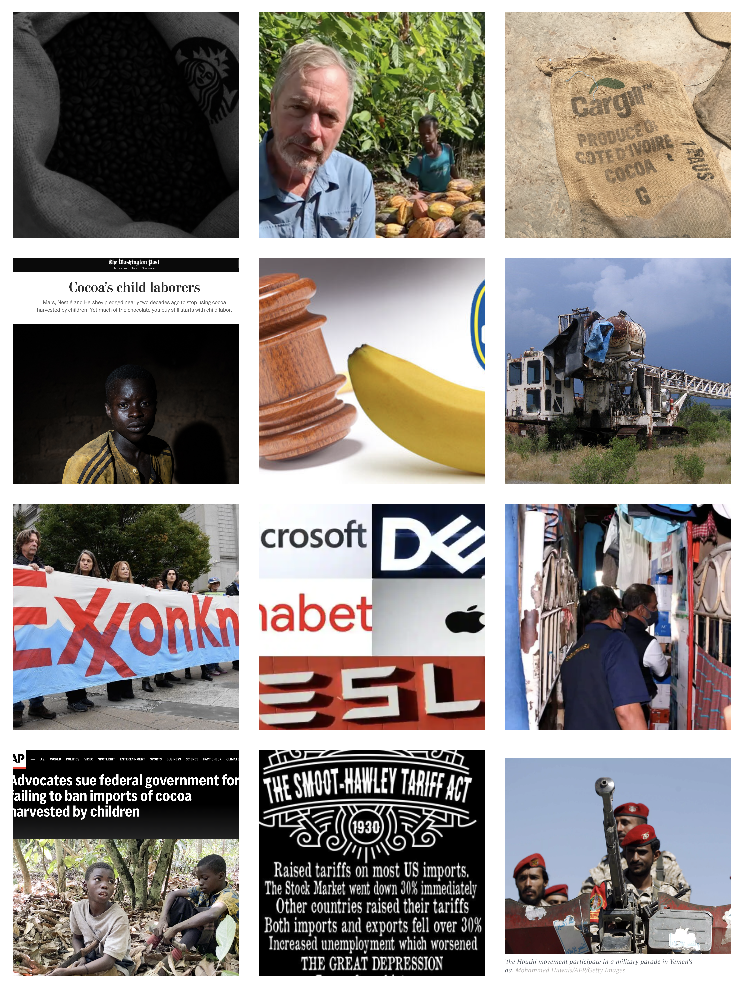
Some of the cases IRA advocates for – in cocoa and more.
A Way Forward
This is going to be the closing topic for this episode, so you’re going to have to watch the episode for my thoughts. Those thoughts will also preface what I will propose in the Tuesday, November 18th episode.
Resources and Other Reporting
If mentioned during the livestream, they will be added here after the episode goes live.
Comments? Questions?
If you have questions or want to comment, you can do so during the episode or, if you are a ChocolateLife member, you can add them in the Comments below at any time.
Episode Hashtags and Socials
#sustainablecocoa
#cocoa #cacao #cacau
#chocolate #chocolat
#specialtychocolate #craftchocolate #beantobar
#PodSaveChoc #LaVidaCocoa #TheChocolateLife
Future Episodes
November News and AMA
AI, Big Data, and the Future of Chocolate
#PodSaveChocolate and #TheChocolateLifeLIVE Archives
To read an archived post and find the links to watch archived episodes, click on one of the bookmark cards below.
 Clay Gordon
 Clay Gordon


Audio-only podcasts